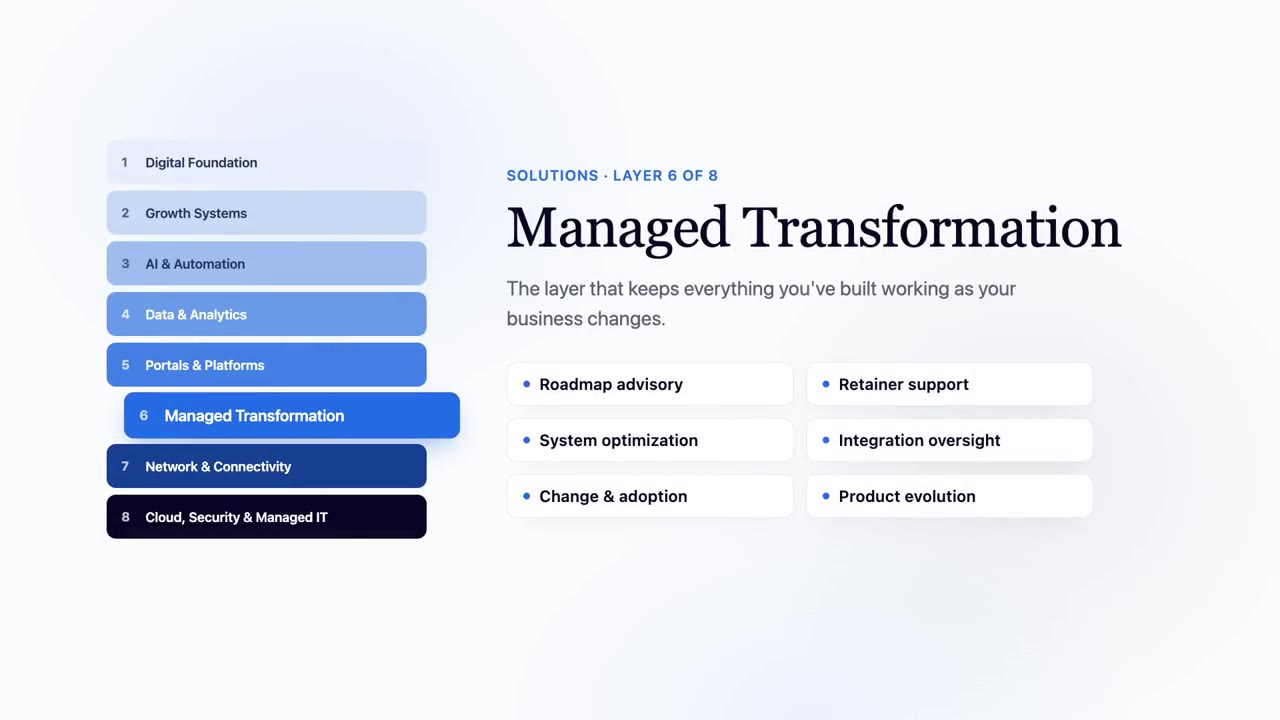
Systems that were built once and never touched again quietly decay into security risk, workarounds, and the exact manual habits you paid to remove. This layer is what keeps everything you've built actually working as your business changes.
The system that solved last year's problem doesn't automatically solve this year's. Without upkeep, teams quietly build workarounds around it instead.
When nobody owns keeping a system current, staff route around it the same way they routed around the manual process it replaced, and the original investment slowly stops paying off.
Ongoing optimization costs far less than letting a system fall behind until replacing it entirely is the only option left.
As your business changes, the systems change with it, without needing to re-explain your business to a new team each time.
Ongoing input on what to build next, and in what order.
A dedicated team on hand as priorities shift.
Continuous tuning of what's already live, not just new builds.
Keeping every system talking to each other as things grow.
Helping teams actually use what's been built, not just switch it on.
Treating your internal systems like a product with a real roadmap.
Most Managed Transformation retainers begin after a Portals & Platforms or Data & Analytics engagement, once there's something real to keep evolving.
Regulated, high-stakes environments benefit most from a stable, ongoing systems partner.
Browse Verticals →See how this retainer model fits into the wider Unilakes Dubai approach.
About Unilakes Dubai →